
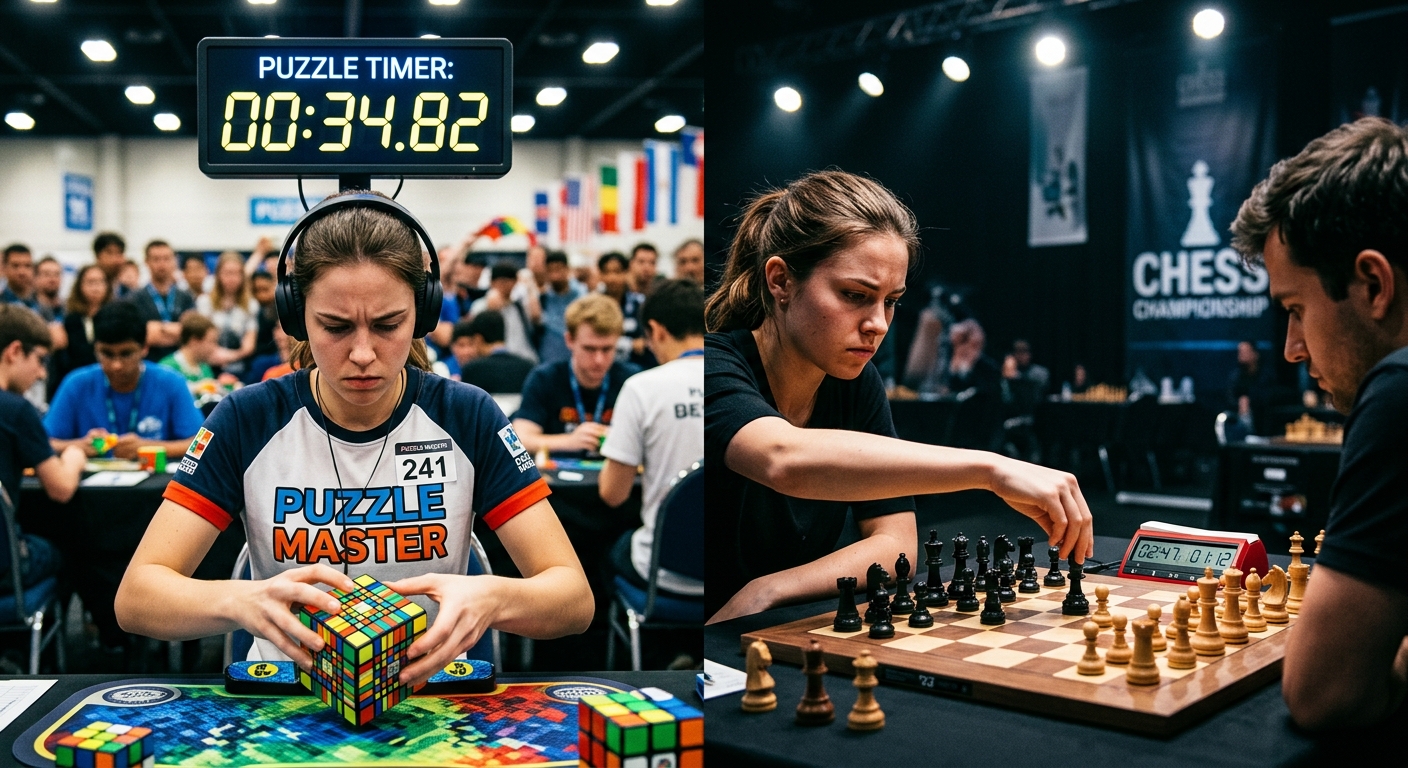
You finish a timed puzzle round with three seconds left on the display. Your answer is locked in. Your pulse is still up. If that scenario feels routine rather than dramatic, you have probably logged serious hours in competitive timed formats, whether number logic grids, speed crosswords, or any event where a countdown governs every decision you make. When you eventually sit behind a chess clock, some of that training carries over in ways you will notice immediately. Other parts, however, may trip you up in ways that are harder to spot.
Time Pressure, Decoded
- Timed puzzle experience builds real clock instincts that give you a genuine head start at the board.
- Chess clock discipline adds a layer that puzzle formats do not: cumulative, position-dependent time that changes with every move.
- Targeted adjustment drills can realign your internal rhythm to tournament-standard time controls.
The Time Instincts You Bring to the Board
Most club-level chess players never had to fight for their relationship with a clock. They learned the game slowly, played casual games at home, and only encountered serious time pressure at their first rated event. You already have something different going into that situation.
Competitive timed formats condition your brain to scan before committing. In a timed grid puzzle, jumping straight to a solution attempt without reading the whole problem first costs you far more time than the scan does. That habit translates directly to chess. Players who survey a position before calculating a line tend to avoid the blunders that come from tunnel vision, especially in time pressure.
You have also internalized what it feels like to keep moving. Freezing on a difficult puzzle during a timed round is devastating. Experienced puzzle competitors develop a feel for when to skip a problem and return, or when to accept a good-enough answer and preserve time for easier gains elsewhere. This mirrors the chess concept of candidate move pruning. If a line is not resolving in a reasonable window, you step back, play the most logical option available, and keep the game alive.
Pattern recognition under pressure is another genuine transfer. Puzzle competition training sharpens your ability to extract signal from noise at speed. That cognitive muscle is directly useful at the chess board when you are scanning for threats or calculating tactical sequences with less than two minutes on the clock.
What Competitive Puzzle Formats Teach About Decision Rhythm
The specific rhythm that competitive puzzle events create is worth understanding in detail. Players who enter a Sudoku competition approach each round with a strategic budget question already in mind: how do I distribute my total time across problems of varying difficulty to maximize my score?
That is a pure budgeting problem. Chess is also a budgeting problem, just one where the structure of that budget behaves differently in critical ways.
In timed puzzle formats, you are allocating time across a sequence of discrete, independent tasks. Each puzzle has a correct answer. Moving on from a stuck position is almost always the right call, because time wasted on one hard puzzle could have secured two easier ones. The scoring structure rewards breadth achieved efficiently.
The decision rhythm that emerges from this training is disciplined and genuinely adaptive. You build an internal metronome. You develop an instinct for when you are spending too long relative to the payoff available. That instinct is not nothing. It is a real asset. The question is whether it maps cleanly onto chess, and in several key areas, it does not.
Where the Chess Clock Operates on Its Own Terms
The chess clock is not running against a shared pool. Each player has their own time, and it depletes at a rate entirely determined by their own decisions. Understanding chess time controls at a structural level matters here, because increment and delay mechanics change the calculus in ways that have no parallel in fixed-timer puzzle formats.
In an increment format like 15+10, you receive ten seconds back after each move. That changes the math of your budget significantly. Spending forty seconds on a single critical decision is not the same catastrophe it would be in a fixed-time puzzle round, because you have been rebuilding your reserve with every preceding move. A delay format, by contrast, gives you a fixed buffer before your clock starts running on each turn, which rewards a different kind of patience entirely.
Beyond mechanics, there is a deeper difference. In chess, not all positions are equally demanding. An endgame with two pawns and bare kings may require almost no clock time per move. A sharp tactical middlegame with multiple forcing lines may justify spending four minutes on a single decision. The correct time to spend per move is not fixed. It varies with the complexity and stakes of each specific position on the board in front of you.
That position-sensitive time allocation is the dimension puzzle competition training simply does not prepare you for. Puzzle formats give you problems of varying difficulty, yes. But they do not train you to read a position in real time and determine how much of your remaining clock budget this specific moment actually deserves.
The Habits That Can Quietly Undercut Your Game
Two failure patterns tend to appear when strong puzzle competitors play rated chess without adjusting their approach first. Both stem from habits that were efficient in their original context.
The first is the search for certainty. In puzzle formats, there is always a correct answer, and reaching it is the goal. Chess positions often do not have a clean solution you can calculate fully to the end of the line. The puzzle competitor's instinct to keep looking until the answer becomes completely clear can drain the clock dangerously in positions where a good-enough move played in time is worth far more than a perfect move played with thirty seconds remaining.
The second pattern is uniform pacing. If your internal metronome was calibrated to spend roughly equal time on problems of similar surface difficulty, you may find yourself rushing through a complex endgame because it looks simple, then lingering too long in a routine middlegame because a superficially tricky line caught your eye. Chess requires variable pacing tied to the position's actual demands, not to a generalized sense of how hard the move looks at first glance.
Adjustment Drills for Recalibrating Your Internal Clock
The gap between puzzle competition instincts and chess clock discipline is bridgeable. The following five drills target the specific areas where the transfer breaks down, with each one building a distinct layer of clock awareness.
- The Phase Budget Drill: Before each training game, assign yourself a target number of minutes for the opening, middlegame, and endgame phases. Review your clock usage after the game ends and compare actual spending against your targets. This builds the habit of thinking about time in relation to the position's phase rather than in absolute terms.
- The Complexity Rating Drill: After each move in a slow training game, write down a number from one to three representing how demanding you felt the position was. Then review your clock consumption per move against those ratings. See whether your spending matched your own read of the position.
- The Forced Move Speed Drill: Play a game where you commit to moving within five seconds on any position where your opponent has only one plausible reply. This trains you to spend nothing on moves that cost nothing, preserving reserve for moments that actually need it.
- The Critical Moment Pause Drill: Identify in advance that any position involving a pawn break, piece sacrifice, or king safety question is a designated critical moment. Give yourself permission to spend up to four minutes on those decisions, and practice recognizing them earlier in your calculation process.
- The Increment Simulation Drill: Play a series of short games at a 5+5 time control and check your clock at move twenty. If you have more time at move twenty than you started with, your increment discipline is working correctly. If you are already in time pressure, your per-move average spending is too high.
Work through these drills in sequence over several weeks. Each one targets a specific failure pattern from the puzzle-to-chess transfer and builds the flexibility your internal clock needs before tournament conditions arrive.
When Two Timers Finally Click into the Same Language
The transition from competitive puzzle formats to chess clock discipline is not a rejection of what you already know. It is a translation. Your core instincts, keeping the game moving, resisting the freeze, reading patterns under pressure, remain genuine assets at the board. The work is in adding the layers that chess specifically demands: variable pacing, increment awareness, and the ability to size up a position in real time and decide how much of your finite clock that moment actually deserves.
Players who arrive from timed puzzle competitions tend to develop solid tournament clock management faster than players starting from nothing, precisely because they already know what it feels like to have time pressure as a factor rather than a background noise. They are not learning to stay composed with a clock running. They are learning a new dialect of a language they already speak with confidence.
The adjustment drills above are the vocabulary course. The board is the classroom. And the clock is already ticking.